Celebrating PTA this Spring Season

A Message from California State PTA President Heather Ippolito

The month of May is full of sweet events! Week of the Teacher, Mother’s Day, and of course, the California State PTA Convention! These events give us the opportunity to recognize key people in our lives. 

Teachers are the heart of the education system. We all can think of a teacher or mentor who made a difference in our lives. Someone who believed in us when we didn’t believe in ourselves. A person who made a complex task seem doable through their instruction. I hope you take time this month to reach out to an educator and say thank you. Even if your children are no longer in the TK-12 school system, find a mentor in your life and let them know how much they are appreciated. 

Another key celebration this month is Mother’s day. I don’t know where I’d be without the examples set by my amazing mother and grandmothers. Motherhood is a huge responsibility and the weight of it is something you carry your entire life. Take time this month to let a mom know that they are doing a good job. Just hearing, “You’re doing great!” can make a mom’s day. 

Finally, May 1-3, local leaders from across the state joined together in Fresno to learn, be inspired by amazing speakers, and expand our circle by connecting with new people. I am so thankful to everyone who joined us, for the volunteers who worked the event, for the incredible Board of Managers and Board of Directors who planned and put on this massive event, and for our staff who supported us every step of the way. Make plans to join us next year in Ontari-OH YEAH from April 30-May 2 so you can be part of the celebration!

Happy May, and thank you for all you do for the children, youth and families in California today, tomorrow, together!

Warmly,

Heather

Heather Ippolito
California State PTA President


A Message from President-Elect Will Sanford

One of the most powerful skills that our children need is the ability to read and truly understand what they are reading. Literacy is a skill that helps level the playing field, as it provides access to information and knowledge- whether from a book or a computer screen. It gives individuals the power to learn. 

Literacy is more than sounding out words on a page. It is the ability to understand the meaning of words, analyze how those words and sentences may impact you, and influence the decisions you make. We read for many purposes, including enjoying creative fiction and poetry, completing class work, filling out job applications, and understanding election ballots. Literacy influences nearly every aspect of life.

Literacy promotes independent thinking, and we want to ensure that all children can access and use that personal power to be the best they can be. We encourage you to read with your child, talk about what you read, explore words and their meanings, and discuss how language can be used to encourage and discourage others. In a world increasingly shaped by digital content and Artificial Intelligence, our children must be equipped to not only read, but to analyze and appropriately use information. 

As Edward Bulwer-Lytton wrote, “The pen is mightier than the sword.” Words shape ideas, decisions, and communities. When children learn to read with understanding, they gain the power to think critically and participate as informed citizens. Literacy is not just an academic skill, it is the foundation of responsible citizenship. By nurturing strong readers today, we help prepare engaged leaders for tomorrow.

Will Sanford
California State PTA President-Elect

Your Mail-In Ballot May Be at Risk in 2026: What California Voters Need to Know

By California State PTA Legislative Advocacy Team

Update (6.1.26)
Watson v. Republican National Committee
, the U.S. Supreme Court case described in this post, has not yet been decided. A ruling is expected by late June 2026. The case has no impact on Tuesday’s June 3 California primary. California’s seven-day ballot receipt grace period remains fully in effect for this election. We will update this post when the Court issues its decision.

California is one of the most mail-friendly voting states in the country. Nearly every registered voter receives a ballot in the mail, and state law allows ballots to arrive up to 7 days after Election Day, as long as they are postmarked by Election Day.

That system is now under pressure from two directions at once: a quiet federal rule change at the U.S. Postal Service that took effect in December, and a U.S. Supreme Court case that could require California to rewrite its ballot receipt rules entirely — potentially before the November 2026 midterm elections.

Here’s what California State PTA members need to understand — and what you can do to make sure your vote counts.

What Changed at the Post Office

The U.S. Postal Service (USPS) clarified on December 24 that a postmark no longer necessarily reflects the date a piece of mail was dropped off. Instead, postmarks are applied when mail is processed at a regional facility — which can happen days after a ballot is placed in a mailbox or handed to a letter carrier.

This shift stems from a major USPS restructuring that has consolidated nearly 200 local mail-processing facilities into 60 regional hubs. The farther a post office is from one of those hubs, the longer the gap between when mail is dropped off and when it receives a postmark. For California, the risk of significant delay is lower than in more rural states — but it is not zero, particularly in rural and inland counties.

The practical consequence: a ballot dropped in a blue mailbox on Election Day may now be postmarked after Election Day, making it ineligible to be counted under California law.

California Secretary of State Shirley Weber called the change a direct threat to vote-by-mail, stating that it “undermines vote-by-mail voting, in turn undermining California and other elections.” Her office has updated its voter guidance accordingly (see below for what to do).

A Supreme Court Case That Could Go Further

The postmark rule change doesn’t exist in isolation. The U.S. Supreme Court is currently deciding Watson v. Republican National Committee — a case with the potential to upend mail voting rules in California and more than two dozen other states.

How the case originated: The Republican National Committee sued Mississippi over a state law that allows mail-in ballots to be counted up to five business days after Election Day, provided they were postmarked by Election Day. The RNC argued that federal law — which establishes a single Election Day for federal offices — requires ballots to be received, not just postmarked, by that date. The U.S. Court of Appeals for the Fifth Circuit agreed, and Mississippi appealed to the Supreme Court.

Where things stand: The Supreme Court heard oral arguments on March 23, 2026. The questioning revealed deep divisions among the justices. Several of the Court’s conservative members expressed sympathy for the RNC’s argument. At the same time, liberal justices raised concerns about the sweeping consequences of a ruling that could invalidate ballot-receipt grace periods in 30 states and the District of Columbia.

The Trump administration, though not a party to the case, filed a brief supporting the RNC’s position. Mississippi’s own attorney general — a Republican — defended the state law, warning that upending ballot-receipt rules in dozens of states just months before a national election “would prompt chaos.”

A decision is expected by late June or early July 2026 — just months before November’s midterm elections.

What This Means for California

California’s current law allows mail-in ballots postmarked by Election Day to be counted if they arrive within seven days after the election. That grace period is precisely what is at issue in Watson.

If the Supreme Court rules in the RNC’s favor, California would likely need to change its law so that ballots must be received — not just postmarked — by Election Day. The USPS postmark rule change compounds that risk: voters who rely on the mail and wait until close to Election Day could face a double jeopardy — a ballot that isn’t reliably postmarked on time and can no longer be counted if it arrives late.

For context: in 2024, nearly 123,000 California mail-in ballots were rejected. A USC analysis found that 27% of those arrived late. Both pressures — the USPS change and a potential Supreme Court ruling — could push that number significantly higher.

What You Can Do Right Now

Whether you’re voting in the June 3 primary or the November midterms, here’s how to protect your vote:

Use a drop box or a vote center. This is the most reliable option for returning your ballot close to Election Day. Drop boxes are available in every California county and are not affected by USPS postmark delays or any potential Supreme Court ruling on receipt deadlines. Find locations at Vote.ca.gov.

Return your ballot early. If you plan to use the mail, do it well in advance — at least one week before the deadline — to allow for processing time.

Request a manual postmark. If you must mail your ballot close to Election Day, take it inside the post office (not a drop box or blue mailbox) and ask a postal clerk to apply a manual postmark on the spot. You must ask — it is not automatic.

Track your ballot. Sign up for the Secretary of State’s Where’s My Ballot? tool at WheresMyBallot.sos.ca.gov to receive text, email, or voice notifications on the status of your ballot. If there’s a problem, you’ll have an opportunity to fix it.

California State PTA’s Commitment to Civic Participation

California State PTA has long held that the right to vote, to cast an informed vote, and to have that vote counted is fundamental to our work — and must be protected. We will continue to monitor both the USPS postmark policy and the Watson v. RNC Supreme Court case and will keep our members informed as developments occur.

In the meantime, share this information with your community. Every vote matters — and every voter deserves to know that their ballot will be counted.

For more on California State PTA’s advocacy work, visit the advocacy section of capta.org. For the latest voter information, visit the California Secretary of State’s website at sos.ca.gov.

The Quiet Power of PTA Safe Schools Advocacy

By the California State PTA Legislation Advocacy Team

Since winter 2025, families across California have been living with a difficult and often frightening reality: immigration enforcement activity near schools and in communities has not let up. The news cycle moves on, but at California State PTA, we hear what’s actually happening directly from our members –  the phone calls, the emails, the conversations at school board meetings. Parents are afraid to send their kids to school. Families are unsure of their rights. Local PTA leaders are wondering what they can do.

If you’re one of those leaders wondering where you fit in, this is for you. Because PTA has something no social media campaign, cable news segment, or protest sign can replicate: trust, built over time, in every community we serve.

We’re Not Just Another Voice in the Room
When a local PTA leader walks into a meeting with a school principal, a city council member, or into a state legislator’s district office, they don’t arrive as an individual parent with an opinion. They arrive as an official representative of their unit, council, or district — carrying the weight of the families who elected them and the credibility of an organization with decades as a trusted child advocate.

Of course, PTA advocacy looks different from what individuals do — and that’s the point. When someone posts on social media or calls into a radio show, they’re speaking for themselves. That matters. But it’s a different kind of voice than what you bring as a PTA leader. Our role is supplemental and distinct: we work alongside individual advocates, building institutional relationships and policy infrastructure that no individual voice can create alone. That’s the quiet power — the steady presence that keeps showing up long after the news cycle moves on.

PTA Members Are Trusted Communicators
PTA’s members are parents, grandparents, students, educators, and community members from every background and walk of life — and that diversity is exactly what makes local leaders so credible. When you speak up as a PTA leader, you aren’t just sharing a personal view. You’re standing in for the families around you who may not know how to navigate these systems, or who may not feel safe doing so themselves. That representative role — rooted in community, accountable to a membership — is something no individual advocate can imitate.

Understanding Our Role and Its Limits
When it comes to immigration enforcement near schools, it’s important to be clear about what PTA members are and what we are not. PTA members are not school district employees or representatives, and we cannot interact directly with federal immigration agents on behalf of a school or district. That is a critical distinction, both legally and practically.

Our role is to inform, advocate, and connect families with the right resources — legal aid organizations, district communications, and community support networks. We help families understand their rights, know what protections exist for students, and know where to turn when they have questions or concerns. That is meaningful, essential work, and it is squarely within PTA’s mission.

When families feel frightened or uncertain about what immigration enforcement near their school means for their child, having a trusted PTA leader say, “I know who can help you, and here’s how to reach them” matters enormously. That’s not a small thing. That is exactly what advocacy looks like from the inside out.

Quiet Doesn’t Mean Weak
PTA advocacy doesn’t always look like a rally or a viral moment. Often, it looks like a local PTA president meeting with her school principal to review the district’s safe schools policy. It looks like a PTA leader calling a state legislator’s office to express support for a bill that would protect students. It looks like a parent sharing a resource sheet at a coffee morning or a back-to-school night.

These moments don’t make headlines — but they move policy. They build the relationships that open doors. They create the kind of sustained, trusted presence that makes legislators and administrators listen when it counts most.

What You Can Do Right Now
As a local PTA leader, you are already doing more than you may realize. Here are a few ways to continue that work with confidence:

  • Connect families with resources. California State PTA’s Safe Schools page is a one-stop hub: it includes our full guidance document, multilingual resources, and the recording of Public Counsel attorney Sharon Cartagena’s LegCon26 presentation — “Creating a Family Plan: What Immigrant Parents and Their Supporters Need to Know.” This video is especially valuable to share widely. Public Counsel also offers free Know Your Rights presentations for community groups; contact them at publiccounsel.org/kyr-immigration-resources.
  • Check in with your local schools — California State PTA’s Advice: Immigration Enforcement Near Schools recommends that schools publicly post CDE guidance materials. Visit your school’s website or front office to confirm these materials are visible and accessible to families — and if they’re not, that’s a conversation worth having with your principal. 
  • ​​Know the law — and hold school leaders accountable to it. California State PTA co-sponsored Senate Bill 98, the SAFE Act, which was signed into law in September 2025. It requires all LEAs — school districts, county offices of education, and charter schools — to update their Comprehensive School Safety Plans to include procedures for notifying the school community when federal immigration enforcement is confirmed on a school site. The deadline for that update was March 1, 2026. Ask your school or district whether their Safety Plan has been updated. If it hasn’t, that’s exactly the kind of accountability conversation PTA leaders are positioned to have.
  • Advocate — and inspire others to do the same. Civic engagement is at the heart of what PTA stands for, and as a local leader, you model it for your entire community. Vote. Attend school board meetings. Respond to legislative calls to action. Contact your elected officials and let them know that keeping schools safe and welcoming for every child is a priority in your community. Then encourage your members to do the same. Every parent, caregiver, and student who shows up, signs a letter, or makes a phone call amplifies the work you’re already doing.

California’s 6 million public school students are fortunate to have advocates like you in their corner. The work you do every day — showing up, speaking up, and staying connected — is the foundation of everything PTA stands for.

Keep going. The quiet work matters most — today, tomorrow, together.

California State PTA Sponsors AB 2651 (Bonta): Informed Parents, Healthy Schools Act

By the California State PTA Legislative Advocacy Team

California State PTA has voted to sponsor California state Assembly Bill 2651, authored by Assembly Member Mia Bonta. The bill, known as the Informed Parents, Healthy Schools Act, would help ensure families receive timely information about vaccination rates in their children’s schools. Here’s what PTA members should know.

What Does AB 2651 Do?
AB 2651 requires the California Department of Public Health (CDPH) to establish immunization rate thresholds needed to prevent the spread of communicable diseases. If vaccination levels at a school fall below those thresholds, CDPH would notify the school, and the school would then notify parents or guardians of enrolled students. The bill is designed to provide parents with clear, school-specific information about vaccination coverage so they can make informed decisions about their children’s health and safety.

Why Is This Needed?
Vaccination programs are widely recognized as one of the most effective public health tools for preventing disease and protecting communities. Research estimates that vaccines have saved more than 154 million lives globally since 1974, the majority of them young children.

Schools are environments where communicable diseases can spread quickly, making high vaccination rates especially important. Maintaining these rates helps support herd immunity, which protects not only vaccinated individuals but also those who cannot be vaccinated for medical reasons.

In recent years, vaccination coverage among kindergarten students has declined below levels needed to maintain herd immunity in many areas. At the same time, currently available data often reports immunization rates only at the county level, which can mask significant differences between individual schools or communities.

AB 2651 addresses this information gap by ensuring parents are notified when immunization rates at their child’s school fall below the thresholds recommended to achieve herd immunity.

Why Is California State PTA Supporting This Bill?
California State PTA’s support for AB 2651 is grounded in our long-standing commitment to protecting the health and safety of children and families.

In our Vaccinations position statement, California State PTA affirms that vaccinations are proven deterrents to diseases that historically have impacted large numbers of children.  Protecting children through immunization also protects entire communities, including medically vulnerable individuals who cannot be vaccinated.

California State PTA has also long supported public education and awareness around immunizations. In the resolution Immunization Awareness and Educational Programs, convention delegates called on PTA to work with public health agencies and local PTA units to promote awareness of the importance of immunization and to alert parents to the potential dangers of disease outbreaks when vaccination levels fall.

AB 2651 supports these goals by improving transparency around school vaccination rates and ensuring that parents receive timely information when immunization levels fall below the levels needed to prevent the spread of disease. By providing families with school-specific information, the bill helps communities respond quickly and helps protect the health of all children.

What Can PTA Members Do?
PTA members can help raise awareness about AB 2651 by sharing information with their local PTA units, councils, and school communities.

Members can also learn more by reviewing the bill language and following advocacy updates from California State PTA. Staying informed and engaged helps ensure that the voices of families are heard in decisions that affect the health and well-being of California’s children. If you are not already subscribed, be sure to join our mailing list today and select “Advocacy & Legislation” to ensure you receive all the latest updates.

Be Empowered by Education at the California State PTA 2026 Convention

By the California State PTA Education Commission

The Education Commission’s convention mantra for Fresno is “Empowered by Education.” Just as students are empowered by their education, parents and caregivers are empowered when they are better educated about California’s educational system. We will present several timely, informative workshops at Convention on topics including: AI, literacy, community schools, school boards, testing, postgraduate options, and education data. Please join us in these empowering workshops, where we make the complex education system more understandable to help you become a better advocate for your school community when you head home!

  • Community Schools’ Positive Impact on Student Outcomes: Efrain Mercado, Director of California Policy at the Learning Policy Institute, will share how California’s Community Schools Partnership Program is transforming student outcomes and strengthening school communities. We will discuss how this statewide investment is helping boost test scores, reduce chronic absence, and lower suspension rates.
  • The Power of Understanding Your School Board: Briana Mullen, Founder and Executive Director of the Education Justice Academy, will explain why school boards are one of the most powerful—and often overlooked—pillars of our democracy. This workshop explores how school boards shape and improve education systems, influencing everything from classroom conditions to long-term district priorities.
  • Essential Guide to Education Information: Discover the best websites for exploring data on school districts and individual campuses, then watch and participate in live demonstrations so you can confidently use these tools on your own to be a more informed parent and caregiver.
  • Strengthening Reading Skills with Targeted Instruction: James Brannon, licensed educational psychologist, will offer a practical look at how a school’s reading intervention system can directly influence student success and long term outcomes. Parents will learn what effective intervention looks like, how to recognize when a system is working well, and what questions to ask when concerns arise.
  • AI Use For Student Success: Ron Ippolito, middle school educator, and James McConihe, author and tech industry veteran, will demystify what AI really looks like in today’s classrooms. This workshop offers a clear, accessible overview of how this rapidly changing technology is being used and how educators are guiding students to use it responsibly. 
  • Pathways to Success: Exploring Community Colleges & Careers: Lori Swain, representing Fresno City College, will offer information about attending community college after high school graduation. This workshop will help families understand the wide range of successful postsecondary options available in California, emphasizing balance, well-being, and lifelong learning rather than a one-size-fits-all definition of success.
  • What’s on the Test? A Hands-On Parent Workshop: Educational Testing Services will lead this interactive session to explore California’s assessments, including CAASPP and ELPAC. You’ll learn how test items are created, scored, and used to support student learning. You will write and score simplified test questions, experience a short practice test, and discover resources to help your school community understand and use assessment results effectively. You will leave with a practical toolkit and ideas to share with other parents and educators.
  • Empowered Pathways: Clear, Practical Steps for Parents and Families Supporting College & Career Readiness: Led by Dr. Darlene V. Willis, Co-founder and Executive Director of Concerned Parents Alliance/College Bound Academy Programs, this panel begins by affirming parents/caregivers as essential partners in their child’s success. Through conversation and real examples, the panel centers on what families need to know to navigate college and career readiness pathways in California, and gives families practical, actionable guidance they can apply immediately into their households.

Communicating About Universal PreKindergarten with Families – A Resource for Families

By the California State PTA Family Engagement Commission

California State PTA is partnering with Universal PreKindergarten (UPK) to share valuable resources for families and children. New materials are now available to help communicate clear, accurate information on early learning programs with families in ways that meet their needs. We know that families get their information about their options from trusted advocates like you.

Check out the Toolkit: Communicating about Universal PreKindergarten with Families that includes customizable materials you can use as-is or adapt for your community:

  • Flyers and posters
  • Social media carousels and sample captions
  • Parent testimonial videos and short clips
  • Email and newsletter templates
  • Talking points and key messages
  • Referral and enrollment resources
  • Links to translated materials

All materials are designed to be easy to share, culturally responsive, and free to use on the UPK website.

DOWNLOAD THE TOOLKIT RESOURCE

PTA Leaders: Help Spread the Word About These Materials To Your PTA Community

Help us make it easier for families to understand their enrollment options by sharing UPK CA materials through your networks. Whether it’s via social media, newsletters, or community events, your support can make a difference!

The materials were shaped to ensure they:

  • Use clear, family-friendly language
  • Explain free and low-cost early learning options in simple terms
  • Reflect the experiences of racially, culturally, and linguistically diverse families
  • Reach families who may not yet be connected to school districts

About the Materials

This project was supported by the generous investment of the Heising-Simons Foundation and Sobrato Philanthropies. It represents a joint venture between the CDE Foundation’s California Family and Community Engagement (CA Face) Initiative, the California Department of Education (CDE) Early Education Division, and Collaborative Communications.

The success of this initiative is a direct result of the project’s Co-Creation Committee; these members stepped up to the charge with immense dedication, ensuring that the community’s voice remained at the heart of every deliverable.

The Co-Creation Committee members included:

  • Nancy Villarreal — Interim Executive Director, Parent Organization Network (PON)
  • Janet Nuñez-Pineda (or representative) — Director, CA State Family Engagement Center, led by The Parent Institute for Quality EducationKeisha Nzwei — Co-founder, Black Californians United for ECE (BLACKECE)
  • Carla Bryant — Founder, The Center for District Innovation and Leadership in Early Education (DIAL EE)
  • Kristel England — Parent Voices
  • Houri Khatchadorian — Vice President for Family Engagement, California State PTA
  • Nina Buthee — Executive Director, Every Child California


Instagram Teen Accounts: Balancing Connection, Creativity, and Safety

By the California State PTA Health & Community Concerns Commission

Social media has become a way of life for adults and teens alike. Instagram is one of the most popular social media platforms for teens, offering a place to connect with friends, explore interests, and express creativity.Its widespread use also raises important questions for families about privacy, safety, and mental well-being.. To address these concerns, Instagram has introduced special protections and features for teen accounts, described in their Parents and Guardians Guide to Instagram.
Age Requirements and Account Setup
Instagram’s minimum age requirement is 13 years old, in compliance with the Children’s Online Privacy Protection Act (COPPA). When users under 18 create an account, Instagram automatically classifies them as teen accounts, applying stricter privacy and safety settings by default. These measures aim to make the platform a safer and more controlled environment for younger users.

Privacy and Safety Features for Teens
Instagram has implemented several tools to protect teens from unwanted interactions and exposure to harmful content:

  1. Private profiles by default: Teen accounts are automatically set to private, helping limit who can view posts and interact with content.
  2. Sensitive content controls: Instagram limits teens’ exposure to sensitive or inappropriate content in areas like Explore and Reels.
  3. Direct message restrictions: Adults cannot message teens unless the teen already follows them.
  4. Parental supervision tools: Parents can connect their accounts to help monitor settings, screen time, and other account activity.

Mental Health and Digital Well-Being
While Instagram can be a place of creativity and connection, research has shown that excessive social media use can affect self-esteem and mental health, particularly for teenagers. To combat this, Instagram has launched initiatives promoting positive online experiences, including:

  • “Quiet Mode” and “Take a Break” notifications encourage users to pause notifications and log off after extended use.
  • Content promoting self-care and body positivity.
  • Partnerships with mental health organizations to provide resources and support directly within the app.

Empowering Teens to Use Instagram Responsibly
Tools matter, but ongoing conversations with trusted adults are just as important in helping teens build safe and healthy digital habits. We should be encouraging teens to:

  • Be thoughtful about who they follow, what they share, and who can see their content.
  • Report bullying, harassment, scams, or harmful content.
  • Use privacy tools actively to control their audience.
  • Take regular breaks to maintain a healthy balance between online and offline life.

Instagram’s teen accounts represent the platform’s effort to balance freedom of expression with safety and well-being. While technology continues to evolve, so must the ways we protect and empower young users online. Through thoughtful features, parental involvement, and open conversations about digital responsibility, Instagram aims to create a space where teens can connect and create—safely.

Celebrate PTA Membership at California State PTA 2026 Convention

By the California State PTA Membership Services Commission

April is National Volunteer Month, which is the perfect time to honor the incredible volunteers who make a difference in PTAs across California. The Membership Services Commission is excited to champion volunteer commitment through impactful workshops and activities at this year’s PTA Convention May 1-3, 2026 in Fresno.

During Convention, our workshops will focus on practical strategies to help PTAs grow and strengthen membership, create impactful programs, and connect with other volunteers from across the state. Whether you are new to membership work or are an experienced leader looking for fresh ideas, these sessions will highlight real examples from PTAs across the state and provide tools you can take home and use right away.

One highlight will be our Membership Idea Exchange, a table-talk style session where participants can connect, share, and discuss membership strategies. These conversations often spark creative solutions and new partnerships, reminding us that no one is doing this work alone.

We are creating opportunities for attendees to make meaningful connections with other PTA volunteers from around the state. These informal networking moments are designed to build relationships, exchange ideas, and learn from one another’s experiences. Volunteers often say that some of their most valuable takeaways from Convention come from the conversations they have with fellow PTA leaders who understand the work they do, and we are looking forward to providing a fun way to help make those connections.

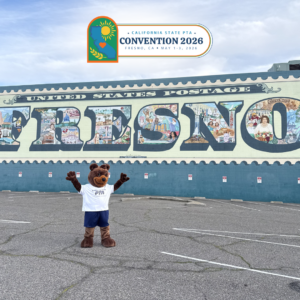
Finally, we invite all volunteers to come to Convention to meet our new PTA mascot, Petey A. Bear, who will make his official debut at this year’s Convention. Don’t miss out on some limited edition Petey A. Bear swag and an opportunity to join the Petey A. Bear Fan Club! 

We can’t wait to see you in Fresno as we celebrate volunteers and continue working together to strengthen PTA membership across California.

Experience the Power of the Arts at California State PTA 2026 Convention

By the California State PTA Arts Education Committee

The Arts Education Committee is looking forward to meeting PTA leaders from across the state at the upcoming State PTA Convention in Fresno (FresYES!) May 1-3, 2026! 

The committee is planning two fun and engaging workshops, an arts education resource room, as well as a hands-on art activity. We invite you to join our workshops listed below:

  • Bringing the Arts to Every Child- Become an Arts Advocate!: This interactive workshop for leaders will be held Saturday afternoon, May 2. Take part in making creative, accessible art activities while learning how the arts support student success. Arts advocates from Create CA will share their tips on how PTA leaders can champion arts programs in their schools and districts .Participants also take home an “Arts Engagement Toolkit” with resources and lesson ideas listing low-cost arts activities they can replicate at school events or family nights!
  • Improv(e) Leadership & Communications: This workshop will be held Sunday morning, May 3. Attendees will participate in improvisational theater exercises designed to improve public speaking, presentation, and leadership skills. Faculty from a Fresno Talent K-8 school will lead interactive improv-based activities and games.

Drop in, open house style, to the Arts in Action! Arts Education Resource Center to meet with arts education committee members, ask questions, obtain resources, and participate in a hands-on art activity. 

Arts education teaches teamwork, leadership skills, public speaking, creativity, and problem solving skills, and you can discover more at Convention. Visit capta.org/convention to register now and we will see you in Fres”yes”!

Recognizing the Dedication of our Incredible PTA Volunteers

A Message from California State PTA President Heather Ippolito

April is Volunteer Appreciation Month. It is the perfect time to thank the PTA volunteers on your campus.  

One of the best ways to appreciate your volunteers is by investing in their personal development and sending them to our California State PTA Convention, May 1-3, 2026, in Fres-YES (also known as Fresno, CA). This allowable expense for your unit, council or district shows that you value your volunteers. Convention offers opportunities to expand knowledge, strengthen leadership skills, and stay informed on issues impacting children and families.It is also a wonderful networking opportunity and a chance to rekindle joy in their PTA work. I hope that you will consider sending some key volunteers to show your appreciation for all they have done and will continue to do for your PTA. 

Personally, I want to take this moment to thank you all for the work you do. Volunteering is the best job you will ever have! It gives us purpose and meaning to be part of the good work of this organization, but volunteering is never easy. You are choosing to give of your time alongside work, family, and other commitments. PTA leaders have the responsibility of IRS compliance, fiduciary responsibilities and navigating challenges within your community. However, you continue to show up, lead, and serve because you know that being engaged in your school community makes a difference for all children and families. 

Thank you for being a part of the legacy of PTA’s work- you are making a difference TODAY, TOMORROW, TOGETHER!

With gratitude, 

Heather Ippolito
California State PTA President